
OUR QUALIFIED STAFF WILL GUIDE YOU TO DISCOVER ARCHAEOLOGICAL SITES AND/OR FOOD AND WINE TOURS IN OUR AREA.
WE OFFER TOURS ON THE AMALFI COAST AND IN THE MOST ANCIENT ONES CITY OF PAESTUM, POMPEII, HERCULANEUM
AND THE HISTORIC CENTER OF NAPLES.
AMALFI
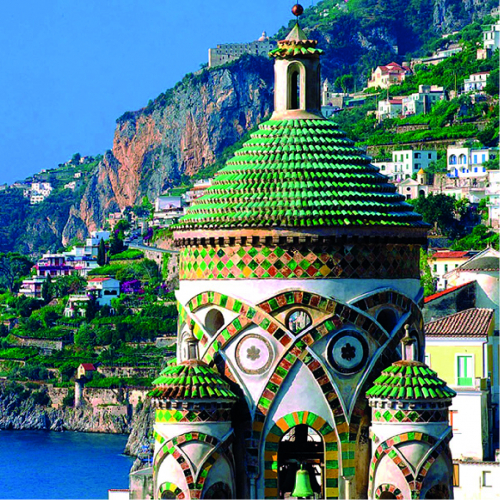
The beating heart of the Amalfi Coast, an ancient Maritime Republic, Amalfi is full of natural, historical and
artistic beauties that you absolutely cannot miss.
A visit to the Cathedral is a must, which is dedicated to Sant'Andrea Apostolo patron saint of Amalfi, was
built in Romanesque style and stands on a suggestive staircase above the homonymous square.
From there you can enter the suggestive narrow streets that run through the city and where you can
discover the various products and typical delicacies of Amalfi.
Also important are the Paper Museum and the Compass Museum through which you can discover the
particular history of this ancient and interesting city.
PAESTUM
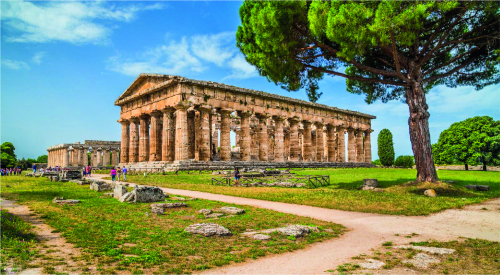
Paestum, until 1926 Pesto[1], is an ancient city of Magna Graecia, called by the Greeks Poseidonia in honor
of Poseidon, but very devoted to Athena and Hera. After its conquest by the Lucanians it was called
Paistom, to then assume, under the Romans, the name of Paestum. The extension of its inhabited area is
still clearly recognizable today, enclosed by its Greek walls, as modified in the Lucanian and then Roman
times.
It is located in Campania, in the province of Salerno, as a fraction of the municipality of Capaccio Paestum,
about 30 km south of Salerno (97 km south of Naples); it is located in the Piana del Sele, near the coast, in
the Gulf of Salerno, north of the Cilento, Vallo di Diano and Alburni National Park; the town, near which
there are Capaccio Scalo and Lido di Paestum, is served by the railway station of the same name.
POMPEI
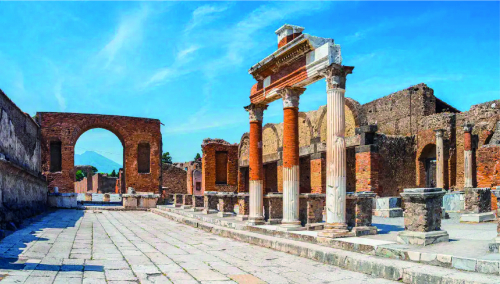
The Pompeii Archaeological Park is one of the most famous archaeological sites in the world, as well as
among the most visited. A World Heritage Site since 1997, it is an unmissable stop during a trip to Naples.
It is an entire Roman city of 2000 years ago which has remained intact over the centuries due to the violent
eruption of Vesuvius which in 79 BC. destroyed the cities of Pompeii, Herculaneum, Stabiae and Oplontis.
Brought to light after years, the city remained crystallized in the moments before the eruption, when a rain
of ashes and lapilli enveloped everything: houses, inhabitants, roads, public buildings and objects of daily
life, stopping everything in a terrible visible snapshot Nowadays.
Precisely because of their uniqueness, the excavations of Pompeii are one of the most visited destinations
in Italy.